
Why Flooring Matters More in Homes with Babies and Young Children
A Child’s World Starts at Floor Level
A Child’s World Starts at Floor Level
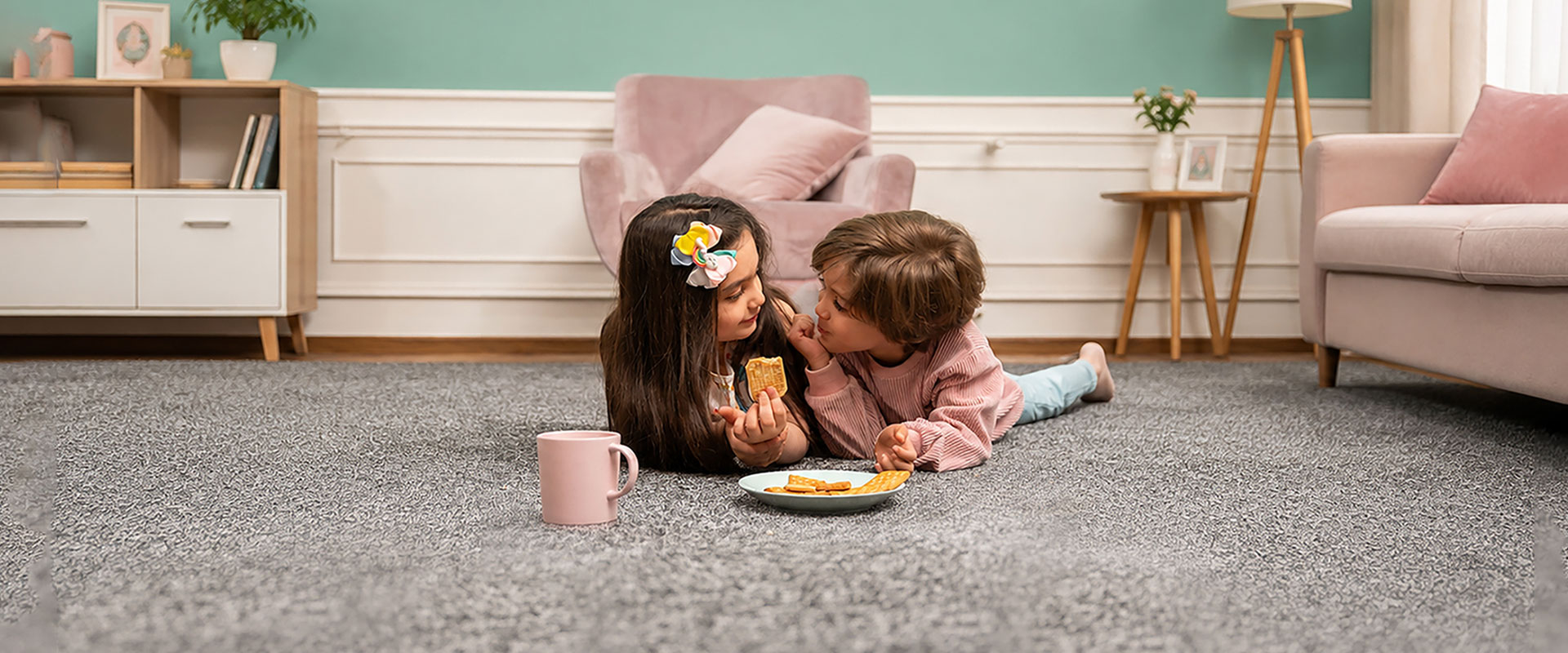
When designing a home for a family with a baby or young child, flooring is often treated as an aesthetic decision.
Color, pattern, texture and style usually come first.
But for children, the floor is much more than a visual surface.
It is where they crawl, sit, play, learn to walk, fall, explore and spend a significant part of their early years.
This makes flooring an important element of the indoor environment particularly during the first years of life.
For architects, interior designers, residential developers, flooring professionals and manufacturers, this raises an important question:
What should we expect from a floor in a child-friendly home?
The answer goes beyond appearance.
The Floor Is a Child’s Everyday Environment
Adults interact with floors primarily by walking across them.
Babies and toddlers experience them very differently.
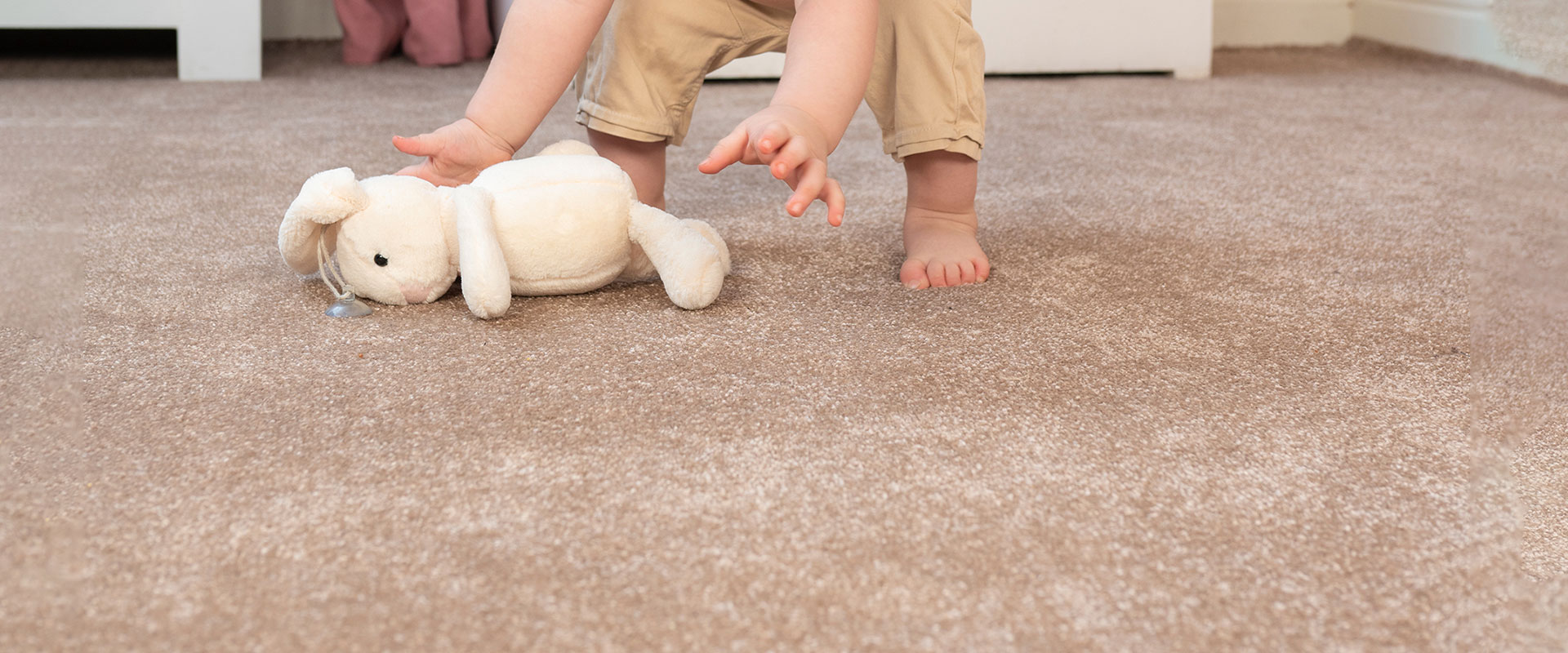
A baby may spend considerable time close to the floor, crawling and playing. A toddler may sit directly on it, play with toys, learn to stand and repeatedly lose balance while learning to walk.
Children’s behavior therefore makes flooring an unusually important part of the residential environment.
The American Academy of Pediatrics notes that children’s developing bodies and their proximity to household surfaces can increase their exposure to environmental hazards.
For designers, this means that flooring should be considered as part of the overall child friendly interior design strategy, rather than simply as a finishing material.
- Comfort Underfoot Matters
One of the most obvious differences between carpet and hard flooring is tactile comfort.
A textile floor covering creates a softer and warmer surface underfoot than many hard flooring materials.
This can be particularly relevant in children’s bedrooms, play areas and family spaces where children spend time sitting or playing directly on the floor.
Comfort is not only about temperature.
The texture and softness of a floor can influence how people use a space.
A comfortable floor can encourage children to sit, play and interact with their surroundings naturally.
For residential designers, this makes carpet an interesting tool for creating spaces that feel more welcoming and comfortable.
- Carpet Can Help Create Quieter Homes
Children create noise.
Toys fall. Objects move. Small feet run across rooms. Furniture is moved. Parents and children interact throughout the day.
In homes with open layouts or hard surfaces, these everyday sounds can become more noticeable.
Carpet can help absorb and reduce certain types of impact and airborne sound, contributing to a quieter interior environment. Research on flooring and indoor environments has identified acoustics as one of the important ways flooring materials can influence comfort and environmental quality.
- This can be particularly valuable in:
- Children’s bedrooms
- Playrooms
- Family living rooms
- Apartments
- Multi-story homes
- Residential developments
In apartment buildings, acoustic performance becomes even more relevant because impact noise can affect the spaces below.
Therefore, flooring selection can contribute not only to the comfort of the child but also to the acoustic experience of the entire household.
- A Softer Surface Can Be Relevant During the Early Walking Years
Learning to walk is a process of constant experimentation.
Children stand up, lose their balance, sit down and try again.
A carpeted surface does not eliminate the possibility of injury, and it should never be considered a substitute for appropriate child safety measures.
However, carpet provides a softer surface than many hard flooring materials and can help reduce the severity of some everyday slips and falls.
The EPA notes that carpet use in schools can contribute to reductions in noise, falls and injuries.
This is one reason flooring should be considered carefully in environments designed for young children.
The objective is not to create a completely risk-free environment which is impossible but to create an environment that is more forgiving of everyday childhood activity.
- Thermal Comfort Is Often Overlooked
For adults, walking barefoot across a cold floor for a few seconds may not seem significant.
For a crawling baby or a child sitting and playing on the floor, the surface temperature becomes much more noticeable.
Carpet provides thermal insulation and generally feels warmer to the touch than hard flooring.
This can make a difference in rooms where children spend extended periods close to the floor.
The result is a simple but important design principle:
A child friendly room should be comfortable at the level where the child actually lives.
For babies, that level may be only a few centimeters above the floor.
- Carpet Selection Matters as Much as Carpet Installation
Not every carpet is equally appropriate for a family home. when flooring is intended for homes with babies and young children, product selection should consider more than appearance. important factors include:
Low-emission materials: New flooring systems, adhesives and underlays can release volatile organic compounds (VOCs). The EPA recommends considering low emitting carpet and adhesives and ensuring adequate ventilation during and after installation. this is particularly relevant when designing children’s rooms.
Appropriate pile construction: Very high pile or excessively textured carpets may be less practical for spaces where children play with small toys or where frequent cleaning is required. a balanced construction can provide comfort while remaining practical for everyday maintenance.
Easy maintenance: Children’s environments inevitably involve spills, food, dust, paint, toys and other everyday messes.
A suitable residential carpet should therefore be compatible with regular and effective cleaning.
Moisture resistance and moisture management Moisture is an important consideration. EPA guidance notes that damp carpet can become a source of microbial growth, making moisture prevention and proper drying essential. therefore, carpet should not simply be selected for softness or appearance. the entire flooring system should be evaluated.
- The “Healthy Carpet” Conversation Is More Complicated Than It Seems
There is an important misconception worth addressing.
It is tempting to say: “Carpet is healthier for children because it traps dust.”
That statement is too simple. carpet can trap dust, pollen and other particles, but poorly maintained carpet can also accumulate contaminants and potentially release particles back into the air during activity. the EPA and independent research both emphasize the importance of effective maintenance, ventilation and moisture control. this means the real question is not:
“Is carpet healthy or unhealthy?”
A better question is: “How does the complete flooring system perform when the right product, installation, ventilation and maintenance practices are combined?”
That is a much more useful question for modern flooring professionals.
- Carpet Can Support More Flexible Child-Centered Spaces
Children’s needs change quickly.
A nursery can become a playroom.
A playroom can become a study area.
A child’s bedroom can eventually become a teenager’s room.
This makes flexibility an important consideration in residential design.
Carpet offers significant possibilities in terms of color, texture, pattern and zoning.
Instead of treating flooring as a uniform background, designers can use different carpet designs to visually define:
- Sleeping areas
- Reading corners
- Play zones
- Study areas
- Family spaces
This creates an opportunity to combine function, comfort and visual identity.
- Modular Flooring Creates an Interesting Option for Modern Residential Design
Carpet tiles are traditionally associated with offices and commercial environments.
But their modular characteristics can also be relevant to selected residential applications.
If a section of flooring becomes damaged or heavily stained, replacing an individual module can be more practical than replacing an entire floor.
For family homes, where spills and localized wear are unavoidable, this can be an interesting lifecycle advantage. the concept is simple:
Design the floor not only for installation, but also for the years that follow.
This lifecycle perspective is becoming increasingly important across the flooring industry. What Should Architects and Designers Consider?
For professionals working on residential projects for families with children, a useful flooring specification checklist can include:
Comfort: Is the surface comfortable for sitting, crawling and playing?
Acoustics: Can the flooring help reduce impact and everyday household noise?
Safety: Does the surface provide appropriate slip resistance and a more forgiving surface for everyday activity?
Indoor Air Quality: Are the carpet, backing, cushion and adhesives low-emitting?
Maintenance: Can the flooring be cleaned effectively and regularly?
Moisture Management: Can the flooring system be protected from prolonged dampness?
Durability: Can it withstand the intensive daily use associated with children?
Design Flexibility: Can the flooring adapt as the child’s needs and the interior change?
These questions create a much more complete approach to residential flooring specification.
The Future of Child-Friendly Flooring
The future of residential flooring is unlikely to be about choosing between “carpet” and “hard flooring” as universally superior options.
Different rooms require different solutions.
Bathrooms require moisture-resistant surfaces.
Entrances may require highly durable and easy-to-clean materials. kitchens have their own performance requirements.
But bedrooms, playrooms and family spaces can benefit from flooring strategies that prioritize comfort, acoustics, warmth, safety and maintainability.
For these environments, carpet remains an important material to consider. the key is not simply putting carpet in a room because it looks comfortable. it is about selecting the right carpet, the right construction and the right installation system for the intended environment. a New Way to Think About Residential Flooring for years, flooring was primarily discussed in terms of appearance and durability.
Today, the conversation is becoming broader. a floor can influence:
Comfort → Acoustics → Safety → Indoor Environment → Maintenance → Long-Term Value
This is especially important when the people using the space are babies and young children.
For architects, designers, developers and flooring manufacturers, the opportunity is to move beyond decorative flooring and think about the floor as part of the overall living environment.
Because when a child spends their first year’s crawling, playing and learning to walk on a floor, that floor is not simply part of the interior.
It is part of their everyday environment.
