
How to Choose the Right Carpet for an Auditorium:
Design, Acoustic and Performance Considerations
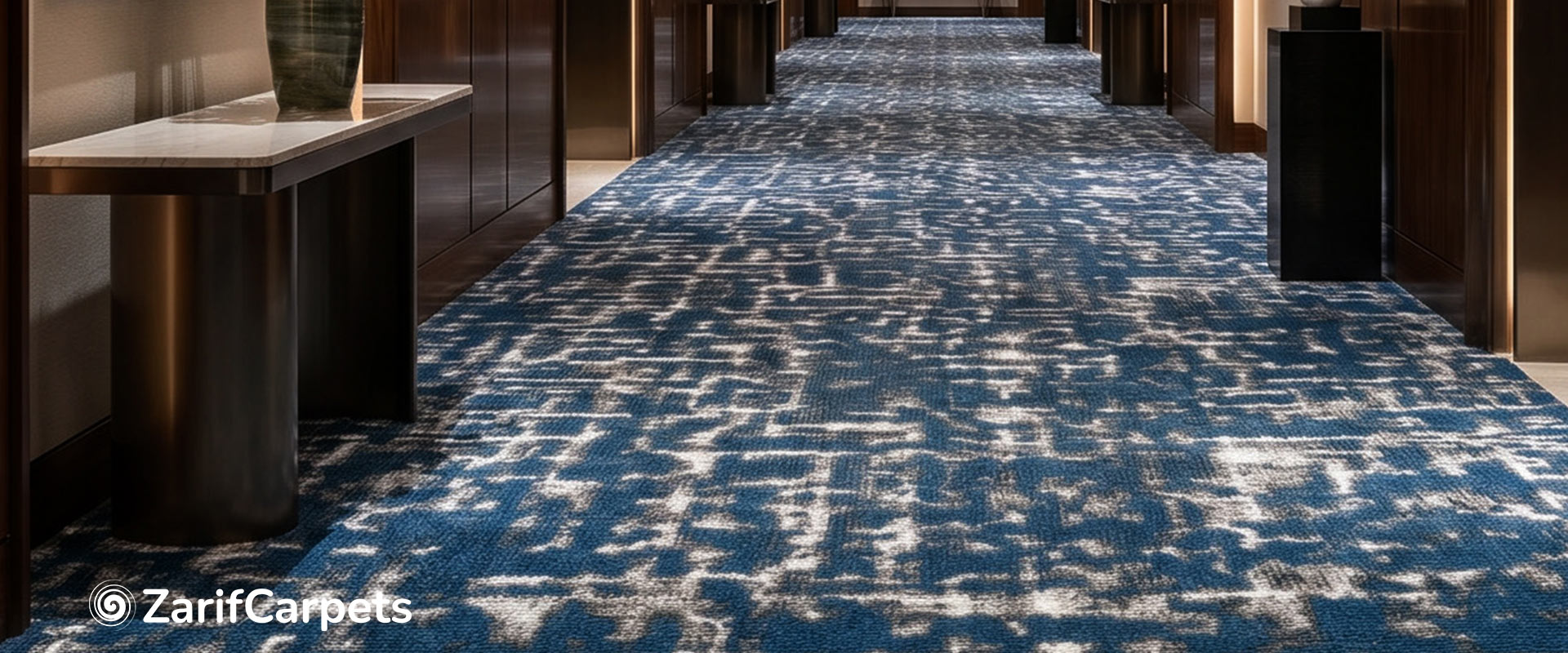
Auditoriums are among the most demanding interior environments when it comes to flooring selection. Unlike a typical residential room or small office, an auditorium needs to accommodate concentrated foot traffic, frequent movement, seating, stairs, entrances, and sometimes large public events involving hundreds or even thousands of people.
At the same time, flooring has a direct relationship with the overall experience of the space. It affects how the interior looks, how comfortable it feels, how footsteps and movement sound, how easy the environment is to maintain, and how effectively the architectural design comes together.
This is why choosing commercial carpet for an auditorium should not be reduced to selecting a color or pattern.
The right product needs to balance aesthetics, acoustic performance, durability, safety, maintenance, installation, and long-term project requirements.
In this guide, we explore the most important factors architects, interior designers, contractors, and procurement teams should consider when selecting carpet for an auditorium, conference hall, theater, cinema, university hall, or other large public interior.
Why Flooring Matters So Much in an Auditorium
Flooring occupies a significant percentage of the visible interior surface, but its role goes far beyond appearance.
An auditorium is a space where different activities take place within the same environment. Visitors may stand in reception areas, walk through corridors, move along aisles, climb stairs, wait before an event, or remain seated for several hours.
Each of these activities places different demands on the floor.
For that reason, the flooring specification should begin with the intended use of the space rather than with a particular carpet color.
A good auditorium flooring specification usually considers:
- Expected traffic volume
- Traffic concentration
- Acoustic requirements
- Fire performance
- Slip resistance
- Comfort
- Cleaning requirements
- Installation method
- Pattern and design
- Maintenance strategy
- Expected lifecycle
The important point is that these factors are interconnected.
For example, a highly textured carpet may create an attractive visual effect, but the same texture may require a different maintenance strategy from a low-profile surface. Similarly, a visually sophisticated design may work perfectly in a reception area but be less appropriate for a high-traffic corridor or staircase.
The best solution is therefore not necessarily the most visually impressive carpet.
It is the carpet that performs appropriately within the complete environment.
1. Start with the Type of Auditorium
Not every auditorium has the same flooring requirements.
A university lecture hall, a luxury hotel conference room, a cinema, a performing arts venue, and a corporate conference center can have very different operating conditions.
Before selecting carpet, it is useful to define the type of project and its expected usage.
Educational auditoriums
Universities and schools can experience heavy daily use, particularly around entrances, corridors, and seating areas.
The carpet may need to withstand repeated movement while also contributing to acoustic comfort.
Conference halls
Conference centers may experience intense traffic during events but lower traffic between events.
This creates an interesting maintenance pattern: short periods of very high use followed by quieter periods.
Theaters and performing arts venues
These environments often place greater emphasis on atmosphere, acoustics, visual identity, and visitor comfort.
Cinemas
Cinemas combine heavy public traffic with acoustic requirements and dark interior environments.
In these spaces, cinema carpet can be selected not only for appearance but also for acoustic contribution and design continuity.
Hotel conference spaces
Hotels may use the same flooring system across reception areas, meeting rooms, corridors, and event spaces.
Here, coordination with the broader hospitality design becomes especially important.
2. Understand Traffic Before Selecting the Carpet
One of the biggest mistakes in commercial flooring is treating the entire room as if it experiences the same level of traffic.
In an auditorium, traffic is usually concentrated.
The center of a seating area may experience relatively limited movement, while entrances, aisles, stairs, and exits may experience significantly more.
This creates different wear zones within the same project.
Typical auditorium traffic zones
Area | Typical Traffic | Main Flooring Considerations |
Main entrance | High | Durability, soil management |
Reception / foyer | High | Appearance + traffic resistance |
Main aisles | High | Wear resistance |
Seating area | Medium | Comfort + appearance |
Stairways | High | Safety + durability |
Back-of-house areas | Variable | Practicality |
VIP / lounge areas | Medium | Design + comfort |
This means the same carpet specification may not necessarily be ideal for every part of the building.
A project may benefit from using coordinated products or different flooring treatments in different zones.
For example, the main auditorium may use a visually refined broadloom carpet while high-traffic entrance zones use a more robust construction.
This approach can help balance design ambitions with real operational requirements.
3. Acoustic Performance: One of Carpet’s Most Important Advantages
Acoustics are particularly important in auditoriums.
Depending on the purpose of the building, sound control may be essential for speech intelligibility, audience comfort, background noise reduction, or overall atmosphere.
Hard surfaces such as stone, ceramic, or polished concrete can reflect sound and contribute to reverberation.
Carpet behaves differently.
Because it is a textile surface, carpet can absorb and dampen some sound energy, particularly compared with hard flooring.
However, carpet should never be considered a complete acoustic solution by itself.
The acoustic performance of an auditorium depends on the complete interior system, including:
- Walls
- Ceiling
- Seating
- Curtains
- Acoustic panels
- Furniture
- Floor construction
- Room geometry
Within that system, an acoustic carpet can make a meaningful contribution.
Why footfall noise matters
Consider the moments before and after an event.
Dozens or hundreds of people may enter the auditorium simultaneously. Footsteps, conversations, movement of chairs, and general circulation can create considerable noise.
A carpeted surface can help soften the acoustic impact of these activities.
This is one reason textile flooring remains relevant in environments where acoustic comfort matters.
4. Carpet Construction Matters More Than the Label
Terms such as “commercial carpet,” “heavy-duty carpet,” or “premium carpet” provide only part of the picture.
A professional specification should examine the actual construction.
Important parameters can include:
- Fiber type
- Yarn structure
- Pile height
- Density
- Pile weight
- Backing
- Tufting construction
- Surface structure
- Installation system
For example, two products may both be described as commercial carpet but perform differently because their construction is different.
Cut pile vs loop pile
A cut pile carpet has yarn loops that have been cut to create an upright surface.
This can provide a softer and more refined appearance.
A loop pile carpet keeps the yarn in loop form, creating a more structured surface.
Neither is inherently superior.
The selection depends on the project.
Cut pile may be considered when:
- A softer visual appearance is desired
- Comfort is important
- The design calls for a more refined textile surface
- Hospitality aesthetics are important
Loop pile may be considered when:
- A more structured appearance is desired
- Traffic is an important consideration
- A textured commercial aesthetic is preferred
There are also products combining different pile structures to create patterns and textures.
5. Broadloom Carpet or Carpet Tiles?
One of the most important decisions in an auditorium project is the flooring format.
The two most relevant commercial formats are broadloom carpet and carpet tiles.
Broadloom carpet
Broadloom carpet is manufactured in rolls and installed over relatively large areas.
It is particularly attractive when the design calls for a continuous surface.
Potential advantages include:
- Seamless visual appearance
- Large-scale patterns
- Strong design continuity
- Suitable for wall-to-wall applications
- Greater freedom for certain customized designs
A broadloom solution can be especially effective in auditoriums where the architectural concept depends on a continuous visual surface.
Carpet tiles
Carpet tiles, or modular carpet, are produced in individual sections.
Their most important advantage is flexibility.
If one area becomes damaged or stained, it may be possible to replace only the affected tile instead of a much larger section.
Comparison
Factor | Broadloom Carpet | Carpet Tiles |
Continuous appearance | Excellent | Moderate |
Local replacement | More difficult | Excellent |
Large pattern continuity | Excellent | Requires planning |
Maintenance flexibility | Moderate | High |
Installation format | Roll | Modular |
Future layout flexibility | Moderate | High |
For a premium auditorium with a strong continuous design concept, broadloom may be the preferred format.
For a multipurpose commercial venue where maintenance and future replacement are major priorities, carpet tiles can offer significant practical benefits.
The best choice depends on the building’s operational model.
6. Fire Performance Should Be Part of the Specification
Auditoriums and public assembly spaces can be subject to specific fire safety requirements.
The exact requirements depend on the building type, country, regulations, occupancy classification, and project specifications.
For this reason, architects and procurement teams should review the fire-performance documentation of the carpet rather than relying on general marketing terms.
Depending on the project, relevant testing and classification may include standards relating to reaction to fire or flame propagation.
The important point is that carpet selection should be compatible with the complete fire strategy of the building.
This is particularly important in:
- Cinemas
- Conference centers
- Hotels
- Universities
- Theaters
- Exhibition venues
- Public assembly spaces
Technical documentation should be requested and reviewed before final approval.
7. Slip Resistance and Stairway Safety
Auditoriums often include stairs, ramps, aisles, and changes in floor level.
This introduces additional considerations.
An anti-slip carpet or slip resistant carpet solution may be appropriate where required, but flooring safety is never determined by carpet alone.
The installation system, stair geometry, no sings, lighting, maintenance, and floor condition all influence safe movement.
Stair areas are also exposed to concentrated traffic.
People repeatedly use similar walking paths, which can create localized wear.
For this reason, stair carpet should be evaluated separately from low-traffic areas.
8. Design: Should Auditorium Carpet Be Neutral or Patterned?
Design decisions depend strongly on the architecture.
A neutral carpet can create a calm background and allow seating, lighting, and architecture to become the main visual focus.
A patterned carpet can create a much more distinctive environment.
Advantages of subtle patterns
Subtle patterns can:
- Add depth
- Break up large surfaces
- Reduce the visual impact of minor marks
- Support architectural zoning
- Create movement
Advantages of plain carpet
Plain carpets can:
- Create visual calm
- Support minimalist architecture
- Make spaces feel larger
- Provide flexibility for future interior changes
The choice between patterned and plain carpet should therefore be connected to the broader visual strategy.
A useful design principle
The more visually complex the architecture, furniture, lighting, and walls are, the more restrained the carpet may need to become.
Conversely, a visually simple interior can accommodate a more expressive flooring design.
9. Color Selection for Large Auditoriums
Color behaves differently in a large room than in a small residential space.
A carpet sample that looks dark in a small showroom may feel surprisingly balanced when installed across hundreds of square meters.
Likewise, very light colors can become visually dominant in a large auditorium.
Darker colors
Darker carpet can create:
- A more intimate atmosphere
- Stronger visual depth
- A sophisticated appearance
- Better integration with theatrical environments
However, darker surfaces can make certain forms of dust or lint more visible.
Mid-tone colors
Mid-tone colors often provide a practical balance.
They can work well in high-traffic spaces because they tend to be visually forgiving.
Light colors
Light colors can make a space feel open and contemporary but may require more attention to maintenance and staining.
10. Consider Cleaning from the Beginning
A carpet that performs well but is difficult to maintain may create problems later.
Auditoriums can experience:
- Food and beverage spills
- Dust
- Soil carried through entrances
- Heavy foot traffic
- Furniture movement
- Periodic large events
Therefore, maintenance should be part of the specification.
A commercial maintenance strategy may include:
Daily or routine vacuuming
Particularly in entrances and traffic zones.
Immediate spot treatment
Spills should be treated according to the manufacturer’s guidelines.
Periodic deep cleaning
The frequency depends on occupancy and use.
Entrance management
Entrance mats can reduce the amount of soil carried into the building.
This is often one of the simplest ways to reduce maintenance pressure.
11. Installation Can Determine the Final Result
Even a high-quality carpet can perform poorly if installation is inadequate.
For an auditorium, installation planning should address:
- Subfloor preparation
- Moisture conditions
- Adhesive requirements
- Seam placement
- Pattern alignment
- Direction of installation
- Transition details
- Edge treatment
- Stair installation where relevant
Pattern alignment
This is particularly important for printed carpet or patterned broadloom.
A small installation error can become highly visible when a pattern repeats across a large auditorium.
For large-scale projects, installation drawings should ideally be reviewed before material delivery.
12. What About Custom Carpet Design?
Large auditoriums often have strong architectural identities.
A custom carpet pattern can reinforce that identity.
Modern production technologies allow designers to work with:
- Geometric patterns
- Abstract graphics
- Brand colors
- Architectural motifs
- Custom color combinations
- Digitally printed designs
A custom carpet design can therefore transform the floor from a neutral background into a genuine part of the architectural concept.
However, customization should not compromise the technical requirements of the space.
The visual concept still needs to work with traffic, maintenance, safety, and installation.
13. A Practical Specification Checklist
Before approving carpet for an auditorium, project teams can use the following checklist.
Specification Area | Key Question |
Application | What type of auditorium is this? |
Traffic | Where are the highest-use areas? |
Construction | Cut pile, loop pile, needle felt, or other? |
Fiber | Is the fiber suitable for the application? |
Acoustic | Does the carpet support the acoustic strategy? |
Fire | Does it meet required project standards? |
Safety | Is the flooring appropriate for stairs and circulation? |
Design | Does pattern and color support the architecture? |
Maintenance | Can the facility maintain it properly? |
Installation | Is the installation system suitable? |
Replacement | How will damaged areas be handled? |
Lifecycle | Is the flooring appropriate for long-term use? |
This approach helps move the decision away from “Which carpet looks best?” toward a much more useful question:
Which carpet best fits the entire project?
14. Common Carpet Selection Mistakes in Auditoriums
Several mistakes appear repeatedly in large flooring projects.
Choosing based on appearance alone
An attractive carpet can still be inappropriate for the traffic level or technical requirements.
Ignoring traffic concentration
Treating all areas equally can lead to premature wear in entrances, stairs, and aisles.
Selecting a pattern without considering installation
Large-scale patterns can require careful planning to maintain visual continuity.
Ignoring acoustic objectives
If acoustics are important, the flooring should be considered as part of the acoustic system from the beginning.
Focusing only on initial price
The lowest purchase price does not necessarily represent the lowest lifecycle cost.
Maintenance, replacement, downtime, and installation should also be considered.
15. Initial Cost vs Lifecycle Value
For a large commercial project, carpet should not be evaluated only by its purchase price per square meter.
A more useful approach is to consider the broader lifecycle.
A simplified lifecycle framework can include:
Initial carpet cost + installation + maintenance + replacement + operational disruption
This does not mean a more expensive carpet is always better.
Instead, it means that purchasing decisions should consider the total cost of ownership.
For example, a modular carpet may have different initial costs from broadloom, but its replacement strategy may reduce disruption later.
Similarly, a highly durable product may be more appropriate for a high-traffic environment even if its initial purchase price is higher.
The correct decision depends on the project’s complete operating model.
16. Final Thoughts
Choosing carpet for an auditorium requires a balance between architecture, technical performance, and long-term operation.
The best carpet is not simply the one with the most attractive color or the highest specification in one category.
It is the product that brings multiple requirements together:
design + acoustics + traffic performance + safety + maintenance + installation + lifecycle value
For architects, designers, contractors, and procurement teams, this means carpet selection should begin long before the final purchasing stage.
The earlier the flooring is considered as part of the architectural and operational strategy, the easier it becomes to select a solution that performs successfully over time.
In an auditorium, the floor is not merely the surface beneath the audience.
